
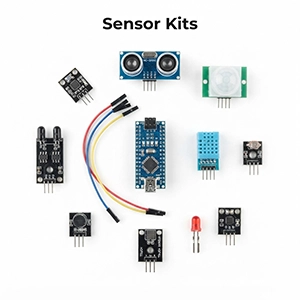
Sensor Kits
Sensor Kits – All-in-One, Motion & Arduino Sensor Kits for DIY Projects
No products found.
Sensor Kits for Electronics and DIY Projects
An all in one sensor kit provides several sensors in one convenient package. These kits help users learn how electronic sensors detect changes in their surroundings. Depending on the kit, sensors can detect motion, light, temperature, distance, sound, humidity, touch, or other conditions.
Sensor kits are useful for electronics learning, Arduino projects, robotics, automation, and DIY experiments. They allow users to test different sensors without purchasing each component separately.
Features of Sensor Kits
An all in one sensor kit may contain multiple sensor modules with different functions. Common examples include ultrasonic sensors, infrared sensors, temperature sensors, light sensors, sound sensors, and motion sensors.
A motion sensor kit can help users experiment with movement detection. Other modules can be used to measure environmental conditions or detect objects and changes in light.
Many kits use simple connection pins. This makes them convenient for breadboards and development boards. However, users should check voltage, pin configuration, and compatibility before connecting a sensor.
Sensor Kit for Arduino Projects
A sensor kit for Arduino can be useful for beginners and experienced makers. Arduino boards can read signals from compatible sensors and use the information to control lights, motors, alarms, displays, and other devices.
These kits can support projects such as automatic lights, obstacle detection, temperature monitoring, security alarms, smart plant systems, and simple robotics.
Who Should Use Sensor Kits?
Sensor kits are suitable for students, teachers, hobbyists, makers, robotics learners, and DIY electronics enthusiasts. Beginners can use simple sensor modules to understand basic input and output concepts.
Students can use them for school and college projects. Adults can use sensor kits for hobby projects, automation experiments, and prototype development.
Before checking the sensor kit price, consider the number of sensors, sensor types, compatibility, documentation, and included accessories.
Pros and Cons
Pros:
Includes multiple sensors in one kit.
Useful for Arduino and robotics projects.
Supports practical electronics learning.
Suitable for different types of experiments.
Sensors can be reused in compatible projects.
Cons:
Compatibility varies between sensor modules.
Beginners may need help understanding wiring.
Some kits may include sensors that are not needed for basic projects.
Additional boards or components may be required.
Brands and Buying Guide
Sensor kits are available from various electronics, educational, and robotics brands. When comparing products, check the sensor types, operating voltage, interface, quantity, documentation, and compatibility with your development board.
Choose a basic kit for learning. Larger kits may be suitable for users who want to explore robotics, automation, and more complex electronics projects.